
Spanish magazine Fotogramas has been given a full day on the sets of HBO’s Harry Potter at Warner Bros. Studios Leavesden, the same studios where the films were made 25 years ago. Its report is packed with new details, from the scale of the production to the smallest Easter eggs hidden in Hogwarts.
A production on a colossal scale
The numbers speak for themselves. The series features more than 200 sets, 1,200 people in the art department and a budget of around $25 million per episode, according to Fotogramas.
Many of the craftspeople have a history with the franchise. Showrunner Francesca Gardiner explained that some worked on the films, and others are the children of people who got their first job there.
Season 1 was shot in chronological order as much as possible. The final scene filmed was Harry’s reunion with the Dursleys on Platform 9¾. In the Great Hall, which can hold 400 children, director Mark Mylod often played 90s house music to keep the young cast energised.
A new Hogwarts Express
The production couldn’t use the train from the films, so it found its own locomotive and carriages. The team kept the exact colours chosen by the films’ production designer Stuart Craig.
The locomotive’s number has also changed. The original 5972 couldn’t be used for legal reasons, so it became 5977. “Seven is also the magic number in this world,” explained production designer Mara LePere-Schloop.
Privet Drive, with real privet hedges
Privet Drive was built outdoors on the studio lot, so that real privet hedges could grow around the houses, a nod to the street’s name that the films never played on.
The Dursleys’ home is a 1990s time capsule, filled with Scrabble, cassettes, Action Man figures, VHS tapes and gossip magazines with Princess Diana on the cover. The Muggle world uses more saturated, artificial colours, to contrast with the natural tones of the wizarding world.
A Diagon Alley inspired by Edinburgh
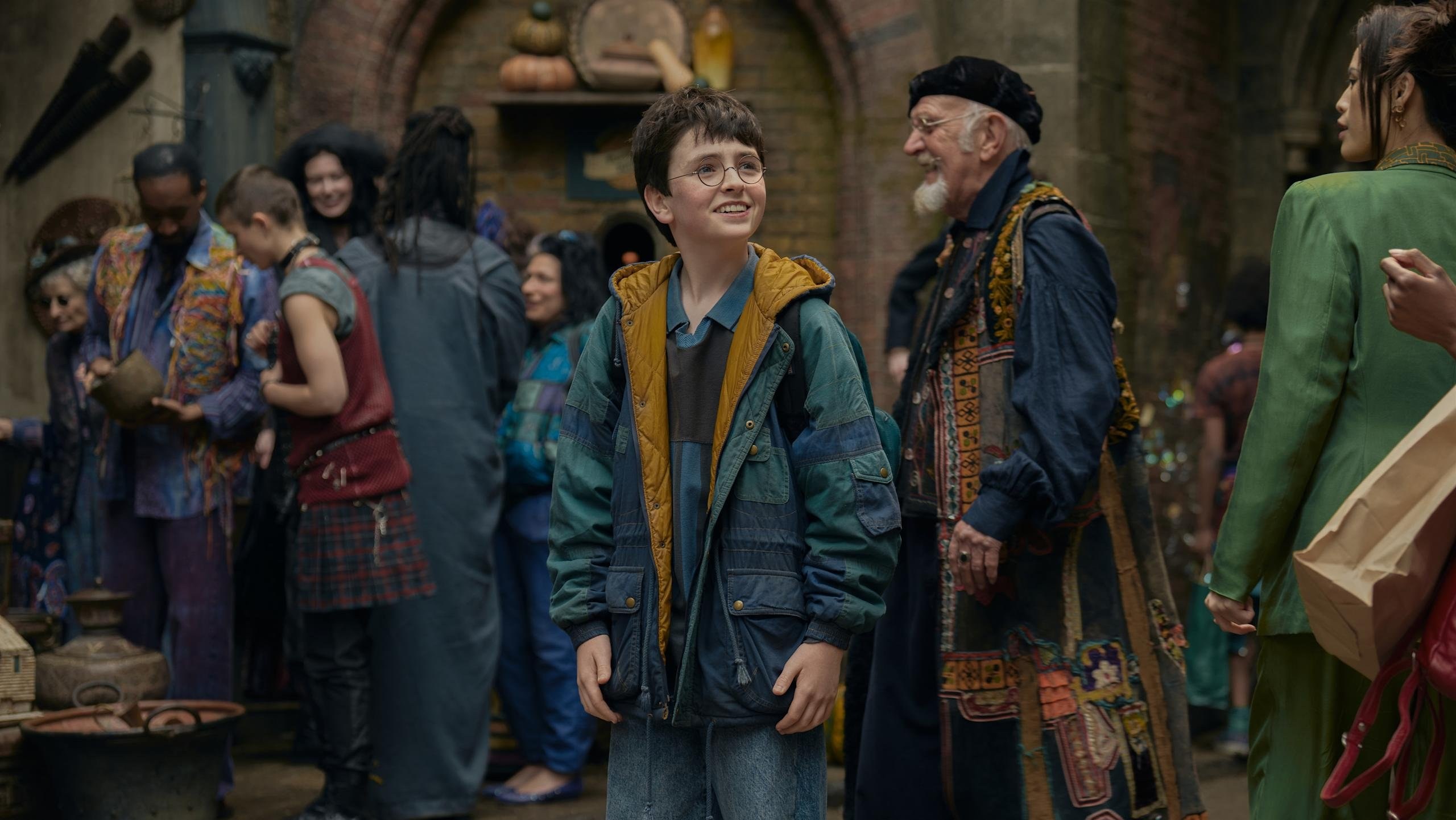
Diagon Alley has close to 40 shops spread over two levels, each with its own identity. Its layout was inspired by Victoria Street in Edinburgh. Plants, flowers and mushrooms grow out of the façades, and one episode features a shot following an owl along the entire street.
At Ollivanders, more than 16,000 real wand boxes fill three-quarters of the shop, and a dragon heart rests on the counter, used to extract the cores of the wands. Gringotts has its own currency, coin-sorting machines, a numbering system for the vaults and lamps decorated with sphinxes guarding the bank.
Magic that could be real
The guiding idea behind the series is naturalism. “We wanted to make magic accessible, far from the Marvel universe, where everything is so exaggerated it’s hard to believe,” Gardiner said.
To achieve that, the team even consulted scientists so that every spell could be explained or designed from a scientific basis. The Muggle world is faithful to 1991, while the wizarding world is rooted in reality, even when extraordinary things happen.
How Hagrid comes to life
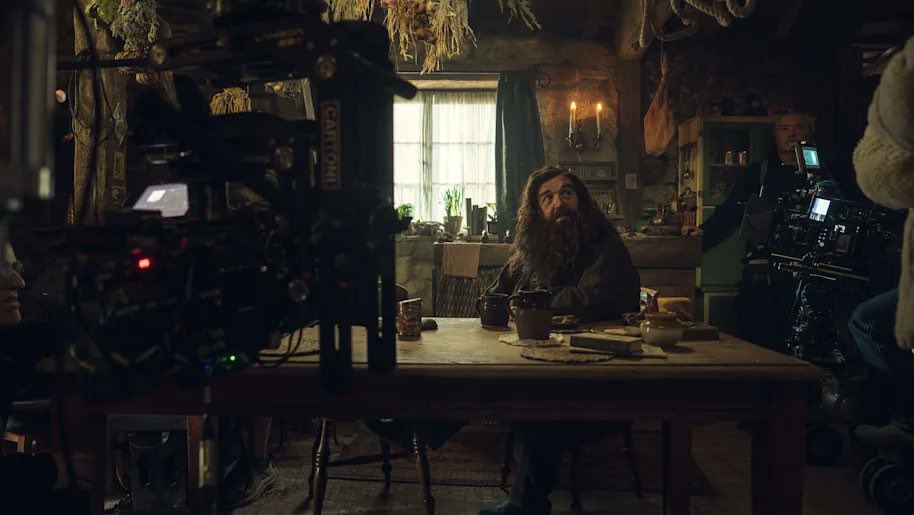
Bringing a half-giant to the screen requires several tricks. Nick Frost’s double, Tony, is a 7’2″ former police officer who wears an animatronic head reproducing Frost’s features, with a camera hidden in one nostril so he can see where he’s walking. Under Hagrid’s 23 kg (50 lb) coat, his first day of filming took place during a heatwave, on the escalators of the London Underground.
Depending on the shot, the team uses Frost standing on a box, Tony, or a version that is almost 8 feet tall. Even when an animal will be added later with visual effects, a physical object is placed on set so the children have something to react to.
A Hogwarts you can walk through
The entrance hall is far more gothic than the films’ Victorian staircase, with stairs everywhere in an Escher-like design. In the Great Hall, four golden hourglasses filled with rubies, emeralds, sapphires and diamonds track the House Cup.
Unlike in the films, Hogwarts’ spaces are all connected. A full tour of the castle’s interior sets takes around 45 minutes. Highlights include a library with 45,000 real books (and a bust of David Bowie), a dragon skeleton hanging over the Defence Against the Dark Arts classroom and a damp Potions dungeon several floors below the other sets.
In the staff room, each teacher has their own mug reflecting their personality. Snape drinks from a green glass. Dumbledore’s office spans three floors in a spiral inspired by the Guggenheim Museum in New York, with an alchemy workshop, a chapel-like Pensieve and, of course, lemon drops.
Purple uniforms and a 90s wardrobe
The official Hogwarts uniform is now dark purple, with bottle green as an option. The grey of the films felt too modern, explained costume designer Holly Waddington.
The series is costumed like a period drama set in the early 90s, with a strong hippie and new age influence, while deliberately avoiding a Victorian look for the wizards. Ron wears clunky shoes his mother makes him wear, which Waddington compares to “slices of bread.”
Snape’s wardrobe is more urban, austere and minimalist, reinterpreting Alan Rickman’s iconic look without copying it. Professor Sprout’s fabrics feature leaf prints and cyanotypes made from wild plants picked nearby, while the professors’ costumes, especially Dumbledore’s, draw on rocks and minerals using a paint-marbling technique.
A tribute to Stuart Craig
In one of the castle’s outdoor courtyards stands a bench honouring Stuart Craig, the production designer of all eight films, who died in 2025. Its inscription reads: “In memory of Professor Craig, a wizard of exceptional artistic talent.”
Harry Potter and the Philosopher’s Stone premieres on HBO Max on December 25, 2026.
Source: Fotogramas. Quotes translated.

Leave a Reply